Cats
The cat (Felis catus), also referred to as the domestic cat or house cat, is a small domesticated carnivorous mammal. It is the only domesticated species of the family Felidae. Advances in archaeology and genetics have shown that the domestication of the cat occurred in the Near East around 7500 BC. It is commonly kept as a pet and working cat, but it also ranges freely as a feral cat, avoiding human contact. It is valued by humans for companionship and its ability to kill vermin. Its retractable claws are adapted to killing small prey species such as mice and rats. It has a strong, flexible body, quick reflexes, and sharp teeth, and its night vision and sense of smell are well developed. It is a social species, but a solitary hunter and a crepuscular predator.
Cat communication includes meowing, purring, trilling, hissing, growling, grunting, and body language. It can hear sounds too faint or too high in frequency for human ears, such as those made by small mammals. It secretes and perceives pheromones. Cat intelligence is evident in its ability to adapt, learn through observation, and solve problems.
Female domestic cats can have kittens from spring to late autumn in temperate zones and throughout the year in equatorial regions, with litter sizes often ranging from two to five kittens. Domestic cats are bred and shown at cat fancy events as registered pedigreed cats. Population control includes spaying and neutering, but pet abandonment has exploded the global feral cat population, which has driven the extinction of bird, mammal, and reptile species.
Domestic cats occur across the globe, though their popularity as pets varies by region. Out of the estimated 600 million cats worldwide, 400 million reside in Asia, including 58 million pet cats in China. The United States leads in cat ownership with 73.8 million cats. In the United Kingdom, approximately 10.9 million domestic cats are kept as pets.
Cat examples:


History and mythology
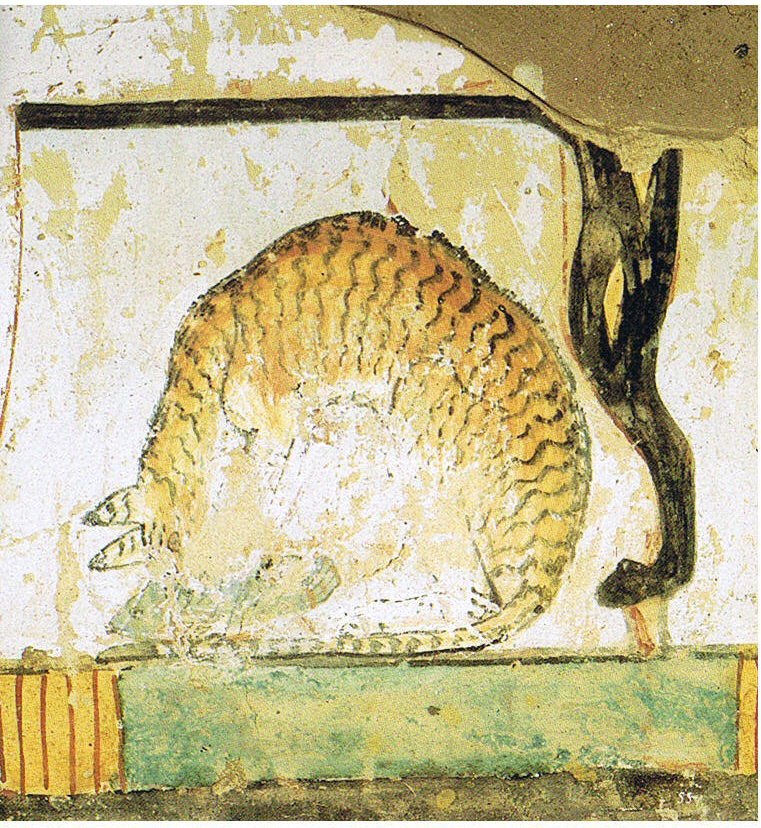
In ancient Egypt, cats were revered, and the goddess Bastet often depicted in cat form, sometimes taking on the war-like aspect of a lioness. The Greek historian Herodotus reported that killing a cat was forbidden, and when a household cat died, the entire family mourned and shaved their eyebrows. Families took their dead cats to the sacred city of Bubastis, where they were embalmed and buried in sacred repositories. Herodotus expressed astonishment at the domestic cats in Egypt, because he had only ever seen wildcats.
Ancient Greeks and Romans kept weasels as pets, which were seen as the ideal rodent-killers. The earliest unmistakable evidence of the Greeks having domestic cats comes from two coins from Magna Graecia dating to the mid-fifth century BC showing Iokastos and Phalanthos, the legendary founders of Rhegion and Taras respectively, playing with their pet cats. The usual ancient Greek word for 'cat' was ailouros, meaning 'thing with the waving tail'. Cats are rarely mentioned in ancient Greek literature. Aristotle remarked in his History of Animals that "female cats are naturally lecherous". The Greeks later syncretized their own goddess Artemis with the Egyptian goddess Bastet, adopting Bastet's associations with cats and ascribing them to Artemis. In Ovid's Metamorphoses, when the deities flee to Egypt and take animal forms, the goddess Diana turns into a cat.
Cats eventually displaced weasels as the pest control of choice because they were more pleasant to have around the house and were more enthusiastic hunters of mice. During the Middle Ages, many of Artemis's associations with cats were grafted onto the Virgin Mary. Cats are often shown in icons of Annunciation and of the Holy Family and, according to Italian folklore, on the same night that Mary gave birth to Jesus, a cat in Bethlehem gave birth to a kitten. Domestic cats were spread throughout much of the rest of the world during the Age of Discovery, as ships' cats were carried on sailing ships to control shipboard rodents and as good-luck charms.
Interaction with humans
Cats are common pets throughout the world, and their worldwide population as of 2007 exceeded 500 million. As of 2024, the domestic cat was the second most popular pet in the United States, with 73.8 million cats owned and around 42.2 million households owning at least one cat. In the United Kingdom, 26% of adults have a cat, with an estimated population of 10.9 million pet cats as of 2020. As of 2021, there were an estimated 220 million owned and 480 million stray cats in the world.
Cats have been used for millennia to control rodents, notably around grain stores and aboard ships, and both uses extend to the present day. Cats are also used in the international fur trade and leather industries for making coats, hats, blankets, stuffed toys, shoes, gloves, and musical instruments. About 24 cats are needed to make a cat-fur coat. This use has been outlawed in the United States since 2000 and in the European Union (as well as the United Kingdom) since 2007.
Cat pelts have been used for superstitious purposes as part of the practice of witchcraft, and they are still made into blankets in Switzerland as traditional medicines thought to cure rheumatism.
